
When Kismet interrupts you, and when it deliberately doesn’t
An app that decides things for a group has an obvious temptation: tell everyone everything, constantly. Every submission, every join, every flicker of activity. Engagement goes up, and the product quietly dies.
Here’s the whole list of what Kismet will interrupt you for.
The eight
- You’re invited. Someone added you to an activity.
- A guest joined. Someone without the app came in by link.
- Picks are sealing soon. Fifteen minutes before the lock. The last useful moment to submit.
- Sealed. The pool is closed. Nothing more to do but wait.
- Fate is drawing soon. Five minutes before the draw — the “get to a screen” nudge.
- It is decided. The reveal is live.
- Nothing to draw. The rare case where a pool sealed empty and there was nothing for fate to pick.
- Friend requests and acceptances. Social, not activity.
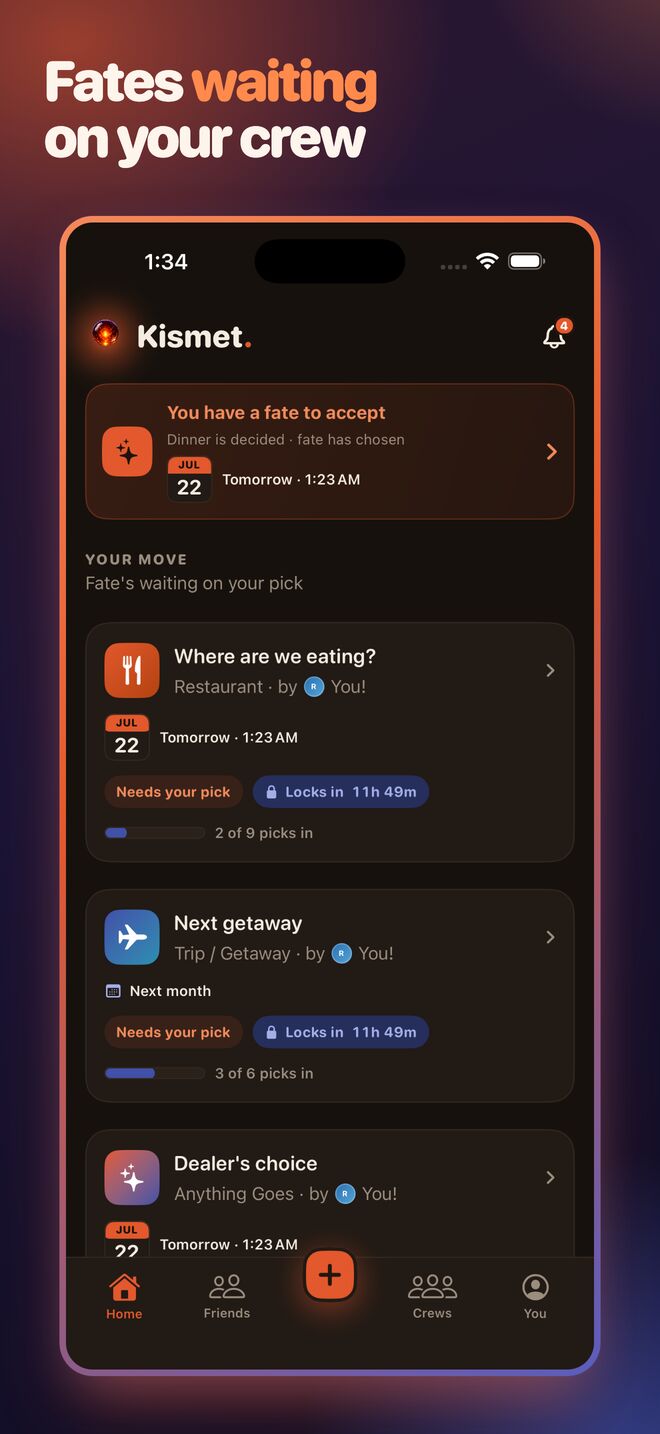
Two of those are timed reminders that exist because of a specific failure: the crew that all meant to submit and collectively forgot. Fifteen minutes before the seal is late enough to be urgent and early enough to act on. Five minutes before the draw is aimed at the room, not the task — it’s an invitation to watch.
The one we don’t send
There is no “Maya submitted a pick” notification. Not a throttled one, not a batched one, not an anonymised one. It doesn’t exist.
It’s the most obviously engaging notification an app like this could send, and it’s incompatible with the thing that makes the draw fair. Submissions are hidden until the reveal — including from the owner. The instant we start narrating who has submitted, the group starts reading the room: who’s in, who’s holding out, who submitted right after you mentioned the Thai place. Anchoring returns through the back door, and the pool stops being independent.
You can still see how many picks are in — that’s a count on the activity screen, not a push, and it never says whose. Numbers are safe. Names are not.
Every notification is also a record
Push notifications are unreliable by nature: permissions get denied, tokens expire, phones stay off. So nothing important lives only in a push. Every notification is written to an inbox in the app first and pushed second. Miss the push and the record is still there, unread, waiting.
The principle
An interruption has to earn itself against a simple test: could the person do something with it, or feel something because of it? Sealing soon, drawing soon and decided all pass. “Someone did a thing” doesn’t — and in this product, it would also give the game away.